Better understand Creative Commons’ non-commercial licenses
Creative Commons offers three licenses that allow others to re-use your material for non-commercial purposes. That material is mostly photos in my case.
It turns out, the least-restrictive one of those three - Attribution-NonCommercial (BY-NC) - is all you need if you only care about the “non-commercial” part.
That sounds kind of obvious, but I was confused by one other non-commercial license.
Here are the three licenses as described on the Creative Commons homepage, ordered from most-restrictive to least-restrictive:
Attribution-NonCommercial-NoDerivs (BY-NC-ND)
This license is the most restrictive of our six main licenses, only allowing others to download your works and share them with others as long as they credit you, but they can’t change them in any way or use them commercially.Attribution-NonCommercial-ShareAlike (BY-NC-SA)
This license lets others remix, tweak, and build upon your work non-commercially, as long as they credit you and license their new creations under the identical terms.Attribution-NonCommercial (BY-NC)
This license lets others remix, tweak, and build upon your work non-commercially, and although their new works must also acknowledge you and be non-commercial, they don’t have to license their derivative works on the same terms.
I want my photos to be available for the widest range of use-cases and people/institutions possible, as long as these use-cases are non-commercial and I get credited. I am fine with modifications of my work, so I didn’t need to use the most-restrictive BY-NC-ND license. For my photos, I chose the middle one: BY-NC-SA. The reason for choosing this one over the less-restrictive BY-NC license was, that I was not sure about this line from the description of that license:
[…]although their new works must also acknowledge you and be non-commercial, they don’t have to license their derivative works on the same terms.
I thought this meant, someone could use my photos, modify them the tiniest bit and then release it under any other license, including one that does allow commercial re-use.
After some research, I discovered that this might be a myth, as Terry Hancock writes:
The only real reason most people care about using “ShareAlike” with “NonCommercial” is because they think it protects them from commercial exploitation of the derivative works.
However, this isn’t necessary. Deriving from a work in order to make commercial use of the derivative is considered “commercial use.”
That describes exactly what I was worried about.
There are some more websites that seem to implicitely support this statement: Creative Commons’ own “Choose a License” page, Flickr’s Creative Commons page as well as this article on the SquidooHQ blog. Here are these parts (emphasis mine).
From Flickr:
Noncommercial means:
You let others copy, distribute, display, and perform your work - and derivative works based upon it - but for noncommercial purposes only.
From SquidooHQ:
You let others copy, distribute, display, and perform your work - and derivative works based upon it - but for noncommercial purposes only. You can also remix, tweak, and build upon the image, use it non-commercially, and license the new version under a different Creative Commons license if you so choose. The new license must be non-commercial.
However, none of these pages list any official sources from Creative Commons - at least not directly regarding these particular statements.
Eventually, I was able to find an answer, buried in Creative Commons’ Frequently Asked Questions. The table under “If I derive or adapt a work offered under a Creative Commons license, which CC license(s) can I apply to the resulting work?” clearly shows, that derivatives/adaptations of work which was originally released under a non-commercial license, can only be re-licensed for non-commercial purposes:
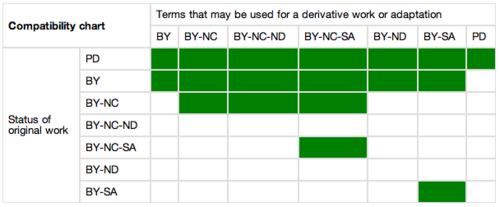
Now I finally feel comfortable using the least-restrictive BY-NC license without having to worry about that derivatives of my work might get re-licensed for commercial purposes.