IndieWebCamp in Düsseldorf
A short summary of IndieWebCamp 2015 in Düsseldorf
And one more IndieWebCamp review by Johannes Dachsel.
Mother, Brother. Châtel 2015.


Indie Web
Another great IndieWebCamp summary by Bastian Allgeier.
Adactio: Journal—100 words 049
Day forty nine.
Here’s Jeremy’s summary of day 2 of IndieWebCamp Germany 2015.
Bummer! Una Pizza Napoletana has moved from New York to San Fransisco. Would have loved to try the pizza. Just watch this video and tell me you wouldn’t like eating pizza there.
(I originally got to know about this place via this video back in 2009.)
Good album: The Sword – Apocryphon.

130/365: Demo time at IndieWebCamp. Aaron Parecki went first.
Adactio: Journal—100 words 048
Day forty eight.
Jeremy wrote up a .
(And if my new h-entry Microformats markup works, this post should eventually show up on his post.)
Adding h-entry Microformat markup to this blog
I’ve just added h-entry markup to all the posts on this blog. I’ll just quote the IndieWebCamp website as to “why”:
Why? This will allow other people’s software to easily read and understand your content. This is useful for a variety of things like recognizing comments, likes, reposts, and displaying reply-contexts for your posts.
For example, if I sent a webmention to someone else’s site/URL1, this other site can easily parse my post and could – for example – display it as a comment.
Another use case that I like, is that the Moncole reader can now parse and display my content.
A small markup roadblock
The best way to use microformats-2 is with as little additional markup as possible. This keeps your code cleaner, improves its maintainability, and thus the quality and longevity of your microformats.
One big advantage of microformats-2 over previous microformats (and others) is the ability to add one class name to an existing element to create a structured item.
So you shouldn’t (necessarily) need to add, remove or alter your existing HTML tags. However, I found this to not be doable in my case.
For texts posts for example, I had a structure like this:
<article>
  <h2>My title</h2>
  Content Content Content Content Content Content Content Content Content Content Content Content Content Content Content
</article>
Marking up the article and h2 elements wasn’t a problem: I just had to add class="h-entry" and class="p-name" respectively. However, I didn’t have a HTML-tag wrapping the content, so there was no tag to put on the extra class="e-content". Hence – with feedback and approval from Jeremy – I had to add an extra div to make this work for me. Here’s the new (simplified) markup for a text post:
<article class="h-entry">
  <h2 class="p-name">My title</h2>
  <div class="e-content">
  Content Content Content Content Content Content Content Content Content Content Content Content Content Content Content
  </div>
</article>
Although I didn’t like having to add an extra div, it’s not a big deal really. I guess I simply found an unfortunate usecase2 that doesn’t quite align with the Microformats2 philosophy of “we do it with class”.
Paar geht mit Mitte 30 in Rente, um zu reisen

Bis zum 67. Lebensjahr arbeiten? Das kann doch nicht alles sein, dachte sich ein Paar aus den USA und brach die Zelte in der Heimat ab, um zu reisen – für den Rest des Lebens. Aber wie geht das?
So nämlich!
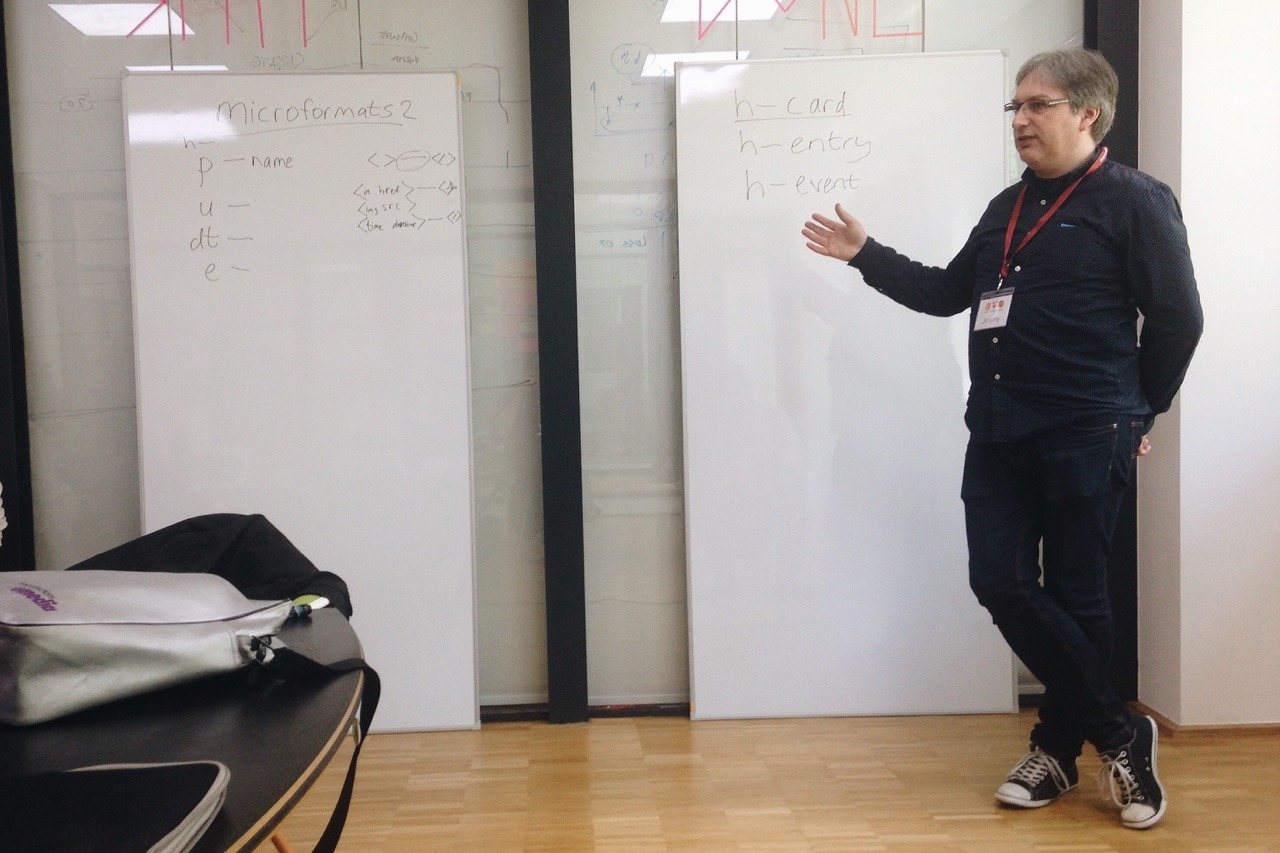
129/365: Learning more about Microformats with Jeremy Keith at IndieWebCamp.
Dan Swanö’s latest project.
And off to IndieWebCamp Düsseldorf…

128/365