log.maniacalrage.net
maniacalrage:
Here’s the frustrating thing about Tumblr: If you ignore all the downtime, errors, server outages and all that annoying stuff, which took sites down for nearly two full days recently and still continues to crop up regularly—if you somehow ignore all of that—simple things still don’t work properly, like the queue.
Sad but true. I have the same problems with the queue. It’s frustrating.
pinboard.in
onethingwell:
Yahoo! are shutting down del.icio.us, ending their careless stewardship of a once-great service.
If you’re still using the bookmarking service, I recommend jumping ship to Pinboard. It will happily import all your del.icio.us bookmarks, and works very much like del.icio.us used to, minus the social aspects.
That’s exactly what I am going to do. I was never really happy with delicious, apart from the fact that I have my bookmarks with me wherever I have an internet connection. Pinboard looks promising and I have looked at it several times now, but never switched (probably due to lazyness and delicious somehow “doing the job”). I guess now’s the right time to finally do it.
I couldn’t believe my eyes when the winners of the 2010 Mix and Mash competition were announced last Friday on Twitter. I read my name for the price of the “Best Visitor Experience using DOC Data” and the “Supreme Mashup” categories (the “Supreme Mashup” is the highest price).
This is more than I have hoped for and a great honour.
The Mix and Mash competition is about creating useful and beautiful mashups and remixes with open data from New Zealand institutions.
My entry is a website to find information about all NZ walking/tramping/hiking tracks: http://nzwalksinfo.co.nz/.

Motivation
The minute I saw that the Department of Conservation made available all the geo data of their walking tracks and huts, I knew I wanted to build a website with this data.
The main idea of the site is to get relevant information on walking tracks in a very visual way. While there are lots of tramping websites already (including the excellent website of the DOC itself), I always found it quite tedious to get to some important information quickly - if it was provided at all.
Here are some of the questions I ask myself quite often and that I think are tedious to answer with existing sites:
- What tracks are available near my current location or a location I’m interested in visiting?
- Will it be stressful with a lot of ups and downs?
- Will I only walk through forest or will I have some nice views along the way?
While I haven’t answered all of these question to my full satisfaction, yet, I think this first version is a very good starting point.
The elevation profile for example was a top priority for me, because it’s so important in my opinion. But yet I can’t find this information most of the time. The DOC makes some elevation profiles available, but only for very few tracks and then you have to get a brochure from a DOC office or download the PDF file.

Future development
Of course, I wanted to do more for this entry, but I ran out of time. I think the site is useful already (eh… obviously ;-)), but it can become a lot more useful in the future while sticking to a simple, uncluttered user interface.
I have lots of ideas and I hope I can implement them in the months to come. Winning the competition definitely is plenty of fuel for my motivation.
Mix and Mash is great
I love the idea behind the competition and I think all entries show that it’s a brilliant idea for NZ institutions to make their data available freely. I think it is a great success. Please check out all the other exciting entries on the Mix and Mash website.
Thank you for this awesome competition. It makes the internet better.
blog.instapaper.com
Great update for one of my favorite iPad apps, including a new feature I have been waiting for (length & progress indicators). But what really strikes me with this update and blog post, is to see how much thought goes into Instapaper’s features and Marco’s attention to detail.
Just look at the section about the new automatic dark mode preference:
You can now have Instapaper automatically use dark mode at night and normal (light) mode during the day.
But how, exactly, do you define “night”? There’s no API access to the iPhone’s ambient light sensor, so I can’t just enable dark mode in dark rooms.
And I can’t just define hour boundaries, because 8 PM in December is much darker than 8 PM in June.
And I can’t just look at hours and the date, because 5 PM in December is much darker in Alaska than in Costa Rica.
So I used with the most reliable method I could think of: sunset times in your location. Yes, Instapaper is now location-aware, but only for this feature.
I love this.
For example, he could have presented that slot-machine-ish control to the user to set the time range when it’s dark. He didn’t and I think that’s awesome, because it makes it almost effortless for the user to use the feature. And it’s very clever.
During the weekend of October 16th and 18th, I participated in the Rails Rumble 2010 coding competition. The exercise was to build a web app from scratch in 48 hours using Ruby and Rails.
Our team consisted of 3 people: Tim, Falk and myself.
The app we produced: Pianrra - An online keyboard with recording and playback functionality.
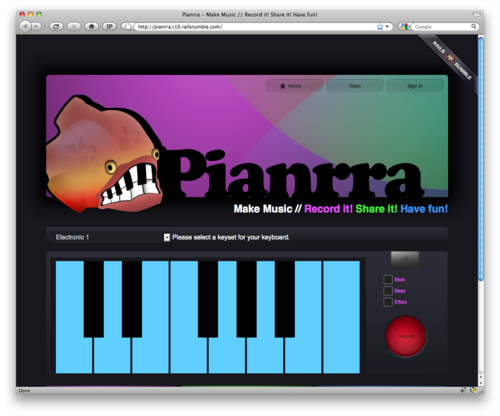
It was a rather spontaneous decision to participate. Falk and I joined Tim - who had registered ealier - only one week before the competition started. Then the planning and prototyping started.
The main reason we participated was to have fun, build something interesting and get smarter (although a little fame and a prize wouldn’t have bothered us, either). That’s also the reason why we chose to implement this particular idea of an online keyboard. It was the most unusual, risky, and exciting idea of all the ones we discussed in the week before the Rumble.
The Rails Rumble is a great exercise in collaboration - especially when you work with a team as distributed as ours. Tim and Falk were working from two different cities in Germany while I was hacking away in New Zealand.
Here are some of my insights.
Plan ahead
You can plan a lot of your project beforehand. This is crucial. When all of the planning is done before the competion, you can fully concentrate on the implementation during the 48 hours.
You aren’t allowed to produce any production ready code or graphics, but there is still plenty you can do. Here are some suggestions of what to think about:
- What app are you going to produce?
- What technologies/plugins are you going to use?
- How’s the user interface going to look like? Create Sketches!
- How are your users going to interact with the site? What’s the workflow?
- What is your database model going to look like?
- What name do you give your product?
Everything you can plan in advance, should be. Unfortunately we didn’t have the time to do so and decided a lot of things during the competition. So there is definitely much room for improvement next time.
Write it down
When you plan all this stuff, write it down! Use a tool of your choice where your team can collaborate easily. This is especially important if you’re not sitting in the same room during the competition.
We used Basecamp to do so and I think it helped a lot. Writing it down helped to clarify the vision for the project (‘What exactly are we going to build?’) and helped to agree on the technologies we are going to use. It definitely eliminated most (if not all) of the existing misunderstandings among the team members.
Additionally, create a list of to-dos and assign each of them to a specific person. It helped us to stay focused, agree on features and - this might seem obvious, but really isn’t - everybody knows what everybody else is doing. (Again, this is especially important if you only collaborate online).
For me, in order for a project to be successful, good communication is essential. And writing down goals, tools, features, to-dos etc. was and is an important part.
UI is important
Rails Rumble confirmed to me again, that the UI is the most important part of the software. What are all your amazing features worth when almost nobody can figure out how to use them? Right. Not much.
I won’t say that it was that bad in our case, but we certainly had quite a number of confused users. We made quite a few quick decisions during the competition (especially towards the end) and these obviously weren’t the best. We also struggled with finishing on time and so certain features and improvements didn’t make it. Additionally we also had to deal with more or less unexpected browser and OS incompatibilities. If we had planned beforehand, this would have been less of on issue.
So: get your UI, workflow and copywriting right!
There’s a lot of competition during Rails Rumble and people simply don’t have the time and/or energy to figure stuff out for every app. I know this from myself: I looked at every of the other 179 apps, and when something wasn’t clear to me, didn’t work etc. I just moved on to the next one.
Conclusion
Altogether it was great fun. Sometimes stressful and exhausting, but still fun. We learned a lot and successfully delivered a working application. I am really looking forward to next year’s edition.
Check out our app Pianrra. (You might need these instructions.)
Miscellaneous Notes
- Working in two very different time zones (GMT+1 and GMT+13) is awesome. You can work around the clock.
- Janrain Engage authentication worked beautifully. It saved us lots of time.
- I used Basecamp for the first time. Loved it. There was no learning curve and it’s very intuitive.
- We kept in touch via Skype’s group chat and conference calls.
- Splitting the project into two sprints worked very well.
tumblr.5v3n.com
Sven’s comment and question after giving his opinion to my GF2 quote post:
And: you need a comment system, Daniel ;-)! Reblogging seems a bit heavy for leaving comments to me.
Doesn’t toto with karakuri look tempting to you?
toto and karakuri do look interesting but not really tempting at the moment. It’s just gives me more stuff to fiddle around with. While I like that, it just prevents me from focusing on the actual purpose of a blog. Tumblr just feels right for me.
Concerning comments, I think this post (not mine) sums it up nicely:
The reblog function allows some sort of commentary but also puts a cost on the commenter. I can reblog somebody’s comment, but my response now goes on my tumblelog with all the other things I put there. If I have something valuable to add, I will add it. If all I have is something stupid ([…]) I won’t bother leaving a comment. It is sort of like a comment—but I have to have it on my tumbelog for everybody to read. By increasing the cost of leaving a comment, reblogging eliminates comments left by people who know they are stupid.
However, I agree that it sometimes is a bit heavy to reblog for a comment. But if you follow me on tumblr, you can leave a reply via the dashboard, which will then show up in the notes.
whowritesforyou.com
minimalmac:
The only way I can focus on my craft and my art is if I don’t constantly dilute it.
Lots to learn from in this excellent post from Randy Murray about the importance of saying “no”: This has been a hard lesson for me to learn (and I’m still learning). More often than not, it is the most compassionate answer one can give. Remembering this bit helps:
The key to saying no successfully is to understand that you are not saying no to everything, you are saying yes to those things you want.
So, so, good. Seriously, if you read nothing else today, read this.
I, agree. But I find the first part of this series even better. Here’s the key passage (at least for me):
If I try to multitask I find that I get absolutely nothing done. It’s only when I can select a specific project and turn off everything else and still the noise of other projects and demands that I can make progress. But the second part of what makes it work is this: I don’t have to focus on one thing exclusively all day long.
I’ve found that if I have specific, short deliverables or milestones I can move a project to a certain state, then take a break and shift to a different project and give it my focus. I am dividing my attention, but I’m dividing it into periods of hours, not minutes or seconds. From the perspective at the end of the day I’ve worked on many tasks and I’ve accomplished a great deal. From the perspective of the hour, I’m laser focused on just one thing. Those who attempt to shift their focus more quickly, from minute to minute, are fooling themselves. It is exhausting and counterproductive.
5by5.tv
marco:
I’m honored to be a guest on one of my favorite podcasts, produced and hosted by the incredibly professional Dan Benjamin.
40 minutes of interesting, insightful talk. Highly recommended!