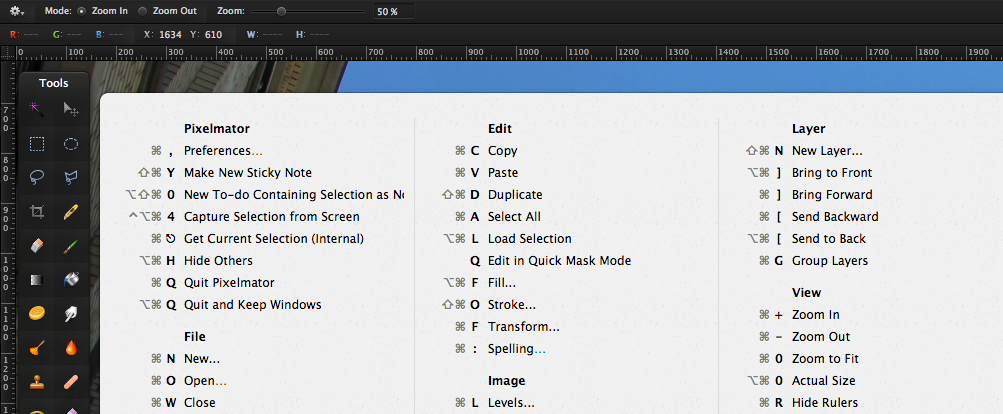
CheatSheet shows you the available shortcuts of the active application after holding the command-key for 2 seconds. Then a panel will show up displaying the shortcuts of the application you are currently working in.
I can see this being incredibly useful to folk who are new to OS X, and existing users who are learning a new, complex app.
I recently got a new MacBook Air at work.
Thanks to the increasing number of tools like iCloud, Dropbox and GitHub I can store and backup more and more of my digital stuff online. This makes setting up a new Mac from scratch pretty effortless. And so I did.
I thought it would be interesting to write down what third-party apps are essential for me to get work done. Here’s the list:
Dropbox
Apart from music, photos and code, I store all my documents here. This also includes my bash profile and gitconfig dotfiles to set up the respective tools.
Rubygems
Essential when programming with Ruby and Rails.
Chrome
Mostly to access Flash content without having to install Flash Player for Safari.
I will install more software as time goes on, but since I didn’t need to install them so far, I wouldn’t call them essential.
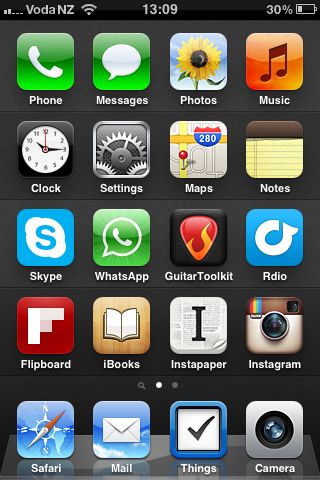
My current iPhone homescreen
“My practice is rooted in minimalism. If someone’s really trying to get something across to someone else, it’s about simplification. Even more than simplification, it’s about rejecting anything nonessential. Edit ruthlessly.”
The only way I can focus on my craft and my art is if I don’t constantly dilute it.
Lots to learn from in this excellent post from Randy Murray about the importance of saying “no”: This has been a hard lesson for me to learn (and I’m still learning). More often than not, it is the most compassionate answer one can give. Remembering this bit helps:
The key to saying no successfully is to understand that you are not saying no to everything, you are saying yes to those things you want.
So, so, good. Seriously, if you read nothing else today, read this.
If I try to multitask I find that I get absolutely nothing done. It’s only when I can select a specific project and turn off everything else and still the noise of other projects and demands that I can make progress. But the second part of what makes it work is this: I don’t have to focus on one thing exclusively all day long.
I’ve found that if I have specific, short deliverables or milestones I can move a project to a certain state, then take a break and shift to a different project and give it my focus. I am dividing my attention, but I’m dividing it into periods of hours, not minutes or seconds. From the perspective at the end of the day I’ve worked on many tasks and I’ve accomplished a great deal. From the perspective of the hour, I’m laser focused on just one thing. Those who attempt to shift their focus more quickly, from minute to minute, are fooling themselves. It is exhausting and counterproductive.
On a mac, you can use Cmd-tilde (⌘~) to switch between the different open windows of an application.
The tilde is conveniently placed right above the Tab key (⇥). So this combination is very similar to the one used to sitch between apps (Cmd-Tab ⌘⇥).
(On the german keyboard layout, the default combination is ‘⌘<’, which is not as conveniently placed as on the english layout. You can change this in System Preferences -> Keyboard and Mouse. I changed it to '⌘^’ which is the equivalent of the english combination.)
“Too much complexity is for people who want to waste their own time. Who has time for that? Every day means a new world we have to create. Futzing and configuring and confusion — these things don’t help.”
“It is your responsibility as a professional developer to properly document software that is intended for use by others. Managing software complexity is a hugely important part of keeping a project efficient, and that’s hard to do if nobody knows how to use your software, or what methods are safe to call.”