I recently had to pull-develop a roll of APX 400, which I unintentionally had exposed at EI200 or even EI100. And I couldn’t find developing times for XTOL online for pulling APX. But I found an entry in a Flickr group, that suggested using 2/3s of the original developing time per stop pulled. That sounded reasonable. So, for my APX 400 in XTOL 1:1, this meant instead of 12 minutes at 20 ℃, I developed for 8 minutes. The negatives came out looking fine.
(This little accident happened, because I loaded APX 400 via a bulk-rolled canister with a 200 ISO DX code into my Leica Mini, which is an automated camera, where you can’t set the ISO manually. And the DX code was even partially covered by tape that I used to label the film. The tape meant, the camera might not have been able to read the DX code at all, making it fall back to its default ISO setting. Which is probably ISO 100 from what I gathered online. Either way, I ended up with an overexposed roll. The question was if it was one stop or two. I decided it was two. But I only compensated for one stop in development, as I thought it’s probably safer to overdevelop a little bit, rather than ending up with too-thin negatives in case it was actually only one stop overexposed.)
For my photo journal, I wasn’t sure how to mark up the piece of HTML that makes up a photo element. And re-reading the spec now, I am still not quite sure.
The site features monthly entries with all the selected photos from that month. Each photo element on a page contains the image itself, plus an optional caption. So I thought it makes sense to group them inside a parent tag (for grouping and styling reasons, as well as semantically). And kind of knowing about the <figure> element, it seemed obvious at first to use exactly that, together with <figcaption>. Like so:
The figure element represents some flow content, optionally with a caption, that is self-contained (like a complete sentence) and is typically referenced as a single unit from the main flow of the document.
[…]
A figure element’s contents are part of the surrounding flow. If the purpose of the page is to display the figure, for example a photograph on an image sharing site, the figure and figcaption elements can be used to explicitly provide a caption for that figure.
As far as my site is concerned, the photos themselves are the main content or flow. I’m not illustrating an article. I’m not referencing images. The images are the article.
And the second quote even speaks specifically of “an image sharing site” – which my photo journal is. But that reads as if the spec speaks about a web page that hosts a single figure – i.e. one that can be referenced from somewhere else.
And that’s why I think <figure> is not the appropriate HTML tag for my use case.
Am I interpreting this incorrectly? Is this nitpicky nonsense? I don’t know. But for now, I decided against <figure>.
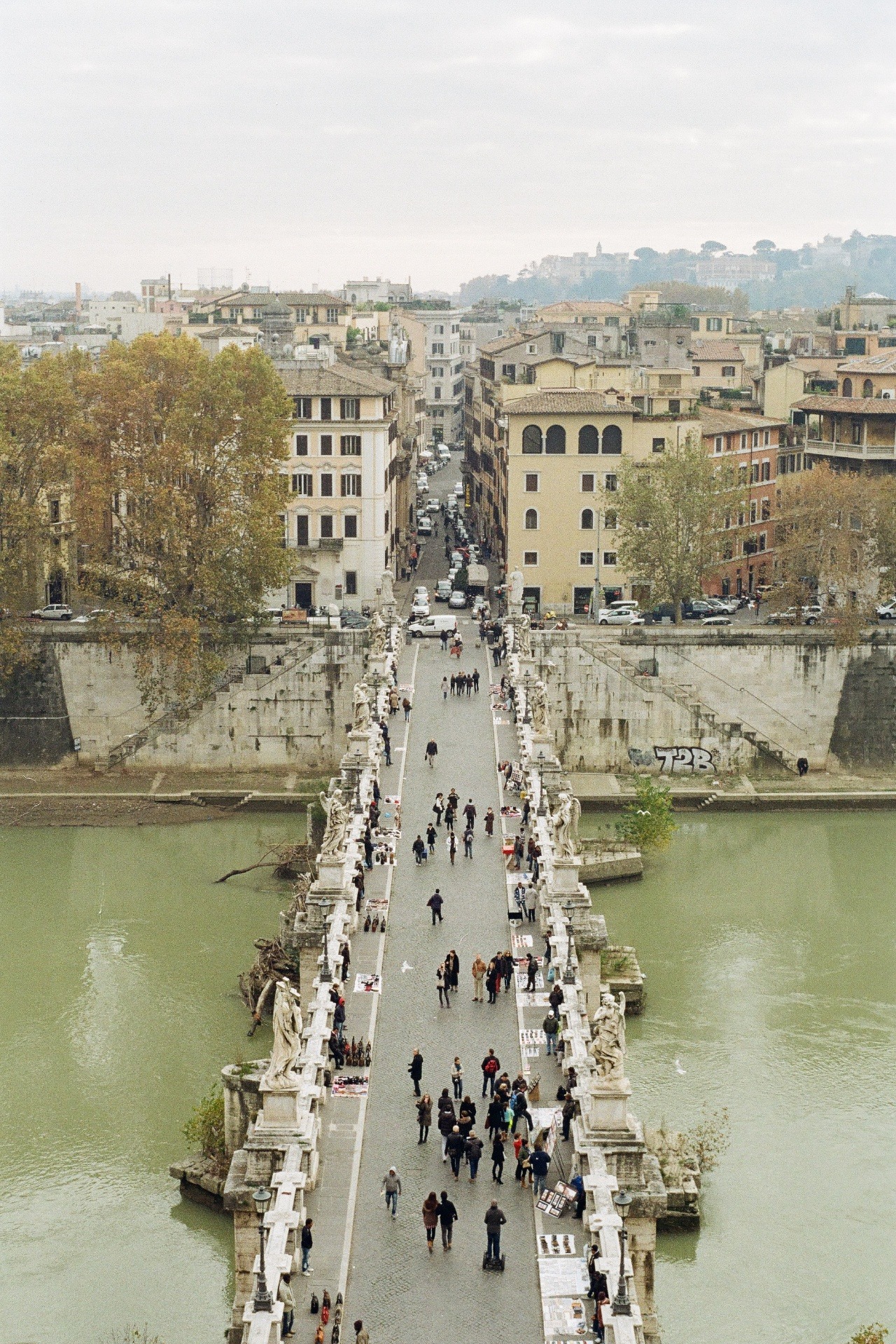
I found this old photo from 2013 in my drafts, and I must say I’m rather pleased with the quality of this scan. I’m pretty sure, this roll was developed and scanned by Foto Görtz here in Düsseldorf. I don’t know what they were (or are) using, but I’m sure it’s something better than the flatbed scanner I use.
This is Kodak Gold 200, shot with a Nikon FE and the 50mm f/1.8 E lens.
And speaking of Matt Stuart: This is a well done one minute video showing him shooting. You may pick up a few techniques: like “scratch-your-nose-to-pretend-your-werent-shooting”, “pretend-to-shoot-something-else-at-first-then-quickly-recompose”, “be-quick” or “take-multiple-shots-of-a-scene”.
Hm… Matt Stuart is giving a workshop in Cologne in June. 🤔 Tempting! But I don’t think I want to spend the money right now. Plus, I feel like my problem is currently less of how to do shoot street photography, but to do it at all. Should really go out more regularly again. Would be nice to see him work and pick his brain, though…
I must say, the older Zoe gets, the more enjoyable and interesting I find it to spend time with her and watch her play and explore. She’s 19 months old now, and it seems like almost every day she’s learning something new.
I’m more and more getting used to a German keyboard layout again. But muscle memory really takes a while to re-adjust after around eight years on an English layout. And I remain sceptical I can ever be as efficient on a German layout when programming. There are just too many common characters “hidden” behind a “shift”-, “option”- or even “shift-option”-shortcut. Symbols like semicolon, brackets, curly braces or backticks are all more cumbersome to type on a German keyboard. And on the Mac terminal I no longer like to set the “Use Option as Meta key”-option – like I used to, to get word-deletion and -skipping – because the pipe (”|”) character is “option-7″ and a backslash is fuckin’ “shift-option-7″. And neither works when that option takes over “option”.
The upside is, I can type German umlauts again easily. Hüürääy!
NightOwl is the perfect Menu Bar App for nocturnal people.
I really enjoy Mojave’s Dark Mode for working during the evening and night. But always going into the System Settings to switch it from the “Light” mode – which I prefer during the day – was a bit tedious. Luckily, Benjamin Kramser thought the same, and created the little NightOwl utility. So that I can now let it automatically toggle between Dark and Light modes based on whether it’s day or night. Sweet!
Guten Ostersonntag mit der Familie verbracht: Gutes Wetter, gutes Essen, gute Gesellschaft. Drumherum waren immer noch ein paar umzugsbezogene Dinge zu erledigen. Reicht auch dann für heute. Gute Nacht!
I know some people simply use water as a stop bath. And I was contemplating trying this approach. But I often read it’s not ideal, because it’ll exhaust the fixer more quickly. And since I now found out about the vinegar approach, I think I’m going to try that instead.
When you miscount and think you have bulk loaded one roll more than you actually have, you run into some problems. When you think, ‘ok, yes, that last roll often has a few more frames on it’ and keep winding but it doesn’t stop even at a frame count of fifty, there has to be something wrong. This just happened to me. And now I have one very very full canister with 50+ frames and one with around 30, which could have easily used another 10 more frames.
One should probably always stop when the canister is full enough. At the worst you’ll have so little film left unspooled, it doesn’t make sense for another roll. But I think that’s better than having to deal with a fat 50-frame roll, where I’m unsure, if it’ll be usable in any camera without issues or whether it’ll fit in the developing tank. I’ll probably just waste a few centimetres and trim that one down to 40+ exposures before using it.
While I’m at recommending music: Revocation is another band I’ve been listening to a lot recently. Really into their “Teratogensis” EP!
A new track from the upcoming The Raconteurs album. Digging it!
And I also bought tickets for both of us for to see them in Cologne in May. So we finally get to see Jack White live. Very much looking forward to this one, too!