Jack White on inspiration, creativity and how constraints help with that.
(via 37signals)
Jack White on inspiration, creativity and how constraints help with that.
(via 37signals)
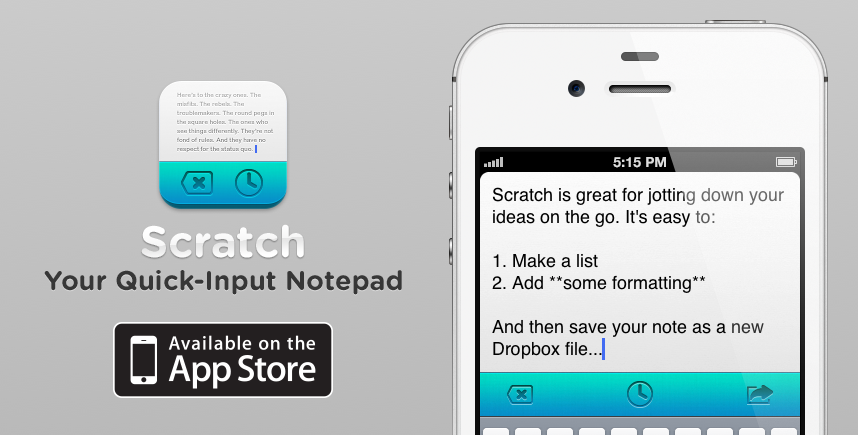
Scratch — Your Quick-Input Notepad
We’ve made loads of apps for clients at Karbon, but this is the first app we’ve made for ourselves. I’m excited to announce the immediate availability of Scratch. We hope it will become your favorite quick-input notepad. It’s crammed full of features like customizable and Markdown toolbars, Dropbox support for appending to existing files or creating new ones, built-in sharing to Twitter and more. It launches lightning-fast, too, and it always jumps right into edit mode so you can start typing right away.
The great thing is Scratch allows you to quickly clear your existing note, but stores all cleared notes in a searchable history so you never have to worry about losing anything. There’s no silly file management to deal with.
Give it a try, we think you’ll like it.
I have been waiting for a note taking app that always starts in editing mode. And it launches lightning-fast indeed. Unlike any other app.
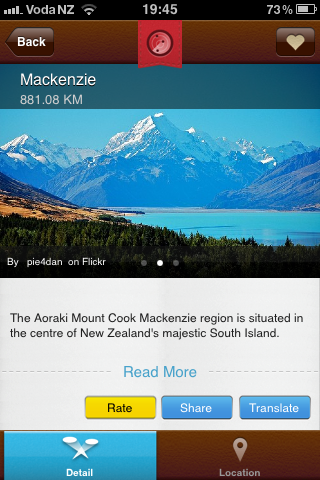
One of my photos is included in the itravelnz iPhone and Android app. Nice.
Henry Rollins shares the story of his life in a 7-minute video.
Matches my experience.
A spectacular ice retreat at the Franz Josef Glacier has surprised experts. The glacier has retreated 500m in four years, prompting suggestions of a road up the valley as the ice disappears from view.
Wow!
Eichenwald’s conversations reveal that a management system known as “stack ranking”—a program that forces every unit to declare a certain percentage of employees as top performers, good performers, average, and poor—effectively crippled Microsoft’s ability to innovate. “Every current and former Microsoft employee I interviewed—every one—cited stack ranking as the most destructive process inside of Microsoft, something that drove out untold numbers of employees,” Eichenwald writes. “If you were on a team of 10 people, you walked in the first day knowing that, no matter how good everyone was, 2 people were going to get a great review, 7 were going to get mediocre reviews, and 1 was going to get a terrible review,” says a former software developer. “It leads to employees focusing on competing with each other rather than competing with other companies.”
If this is true, it strikes me as such an obvious mistake to make at a company like Microsoft. Hard to believe.
But then we started using credit cards remotely, first by making payments over the telephone and later for use over computer networks. Neither physical possession of the cards nor a signature on paper could be used for authentication any more. So the card numbers themselves, along with the three digit security (CVV), codes became the means of authentication. As with Social Security numbers, we ended up using a piece of information for authentication that was never designed to be used that way.
A great post on Identification vs. Authentication, and why it’s unclear to some people, how credit cards and the like work.
So we built in a special feature that’s unique to our [37signals’] Basecamp account that allows us to make one of our projects completely public. It’s read-only, it can’t be changed, but you can see all the discussions, to-dos, files, etc., just as they happened.
It’s pretty amazing they made this public and are planning to make even more projects available publicly. When do you ever have a chance to get such a raw glimpse at how a widely successful company works?
I think it’s fascinating to see how they talk to each other, how they disagree and agree, and how they learn from their own history.
This last example really highlights the benefits of writing things down.
If you have any interest in software development, this is a must-read.
The interesting (to geeks like us) part is this: what system that works like Twitter could exist without a company behind it?
Think about it this way:
Under the hood, following somebody is really just subscribing to a feed of their statuses. Posting is really just updating a feed of your own statuses.
So you standardize on a feed format. RSS would work great, of course, and there’s a ton of RSS reading and writing code out there already — and it’s not like it’s dead. (For instance, just this week Apple released a major iPhone app that uses RSS.)
Any given feed could live anywhere on the web.
It would be amazing if such a thing came to life.
Google open sources their mini moog doodle.
“The intention of this open source project is to provide a moderately complex example of how one might use the Web Audio API to make a digital synthesizer on the web.”
Neat!
Boom!
A blog that collects little software UI details that make software not suck.
My favorite new blog.
Jeff Atwood wanted to find out if his readers could spot the differences between several encodings of the same song in a different quality - from 128 kbps all the way up to raw CD quality.
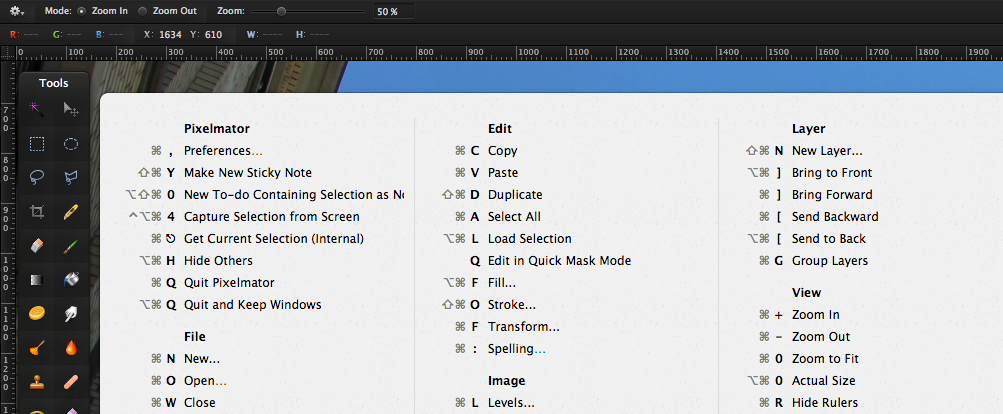
CheatSheet shows you the available shortcuts of the active application after holding the command-key for 2 seconds. Then a panel will show up displaying the shortcuts of the application you are currently working in.
I can see this being incredibly useful to folk who are new to OS X, and existing users who are learning a new, complex app.
Clever.