Also, for existing models with the third-generation keyboard — last year’s new MacBook Pros and the new MacBook Air — if they require a keyboard replacement, they’ll get the new tweaked keyboard with the purportedly more durable mechanism.
Makes me feel a little more comfortable with this new machine.
I recently wrote about why I don’t want to upgrade my Mac right now. But last Saturday, it stopped working again due to that graphics card issue and is in for repair once more. So, I had to buy a new one, because I couldn’t afford to go without my computer for close to two weeks. And I also wanted something reliable again.
I decided on a current 13-inch MacBook Pro, with a 2.3 GHz Quad-Core i5, 16 GB of RAM, an 1 TB SSD, the Touch Bar and a keyboard with German layout.
I bought it refurbished, because that was the only option to get something fitting within two days. Plus, the price was nice. Which luckily means, concern No.2 from my previous post is lessened. But the other points are still a concern for me.
Anyhow, here are some initial observations:
The new high-resolution display is absolutely gorgeous (and True-Tone seems nice as well)!
The trackpad is super nice. Annoyingly, though, I can’t trigger drag-and-drop reliably.
The Touch Bar is not bad. I actually like some features. But while the software Esc-key somewhat works so far, it’s not ideal, as I sometimes either don’t hit it, or hit it accidentally. But maybe I simply need to get used to it more.
Touch ID is neat.
The whole computer looks and feels great.
Only 1.37 kilograms for such a powerful machine is absolutely fantastic.
The keyboard is very nice to type on. But I really hope it’ll keep working.
The German keyboard layout is driving me nuts! I’m slowly re-adjusting, but it’s still pretty frustrating to use.
On the one hand, upgrading to a model that’s more than seven years younger feels amazing. On the other hand, it’s simply another computer I can do my work with again. But no matter how I look at it, I’m very happy so far with this new machine.
I’m using an early 2011 15 inch MacBook Pro. Still! It’s now almost eight years old. And it’s plagued by that issue with its discrete graphics card. After Apple replaced the logic board twice – for free – I got it repaired late last year again (by a third party), and then a couple of days ago another time (under warranty). Before going with the repair, I thought about getting a newer model. It remained being just a thought.
Apart from being a waste of otherwise still very capable hardware, there are three main reasons for this:
The new unreliable keyboard.
Apple’s ridiculous high prices for SSD storage.
The Touch Bar.
I’ve heard and read about too many instances where keys on the new keyboards would stop working properly – even on their latest iteration – that I’m very hesitant to buy one with those in them.
Then there is the price for SSD storage. I want a 1TB configuration, so I can comfortably fit everything I need internally. I don’t want to deal with external drives and all the complexity that comes with that. Annoyingly, upgrading a current MacBook Pro configuration to feature a 1TB SSD instead of the 512GB version costs an additional €500. Which I feel is a rip-off!
And I’m sceptical of the Touch Bar, too. I use the Esc key a lot, and think I would miss having a hardware key for its functionality. So, I’d much prefer a row of function keys.
And that’s why I’ll keep using my trusty old 2011 model. It still performs well with its quad-core CPU, all-SDD storage and a renewed battery. I’m still hoping Apple will get its act together again soon.
The United States government has demanded that Apple take an unprecedented step which threatens the security of our customers. We oppose this order, which has implications far beyond the legal case at hand.
This moment calls for public discussion, and we want our customers and people around the country to understand what is at stake.
I hope most tech companies will finally back Apple in this fight for privacy and freedom!
Disk Utility confirmed that the drive needed repair, but told me I have to repair it when booting from the Recovery Partition. But trying to repair it from there was not successful, either. And from then on the machine refused to boot. It crashed/turned off, right after I entered my password – which I had to enter early, because my drive was encrypted with FileVault.
Btw.: I will actually not use Fusion drive on a Mac as HFS+ is not really keeping my data safe (see my HFS+ fails miserably demo). Using two HFS+ disks concatenated just increases the risk of data failure. And TimeMachine as backup has failed me as well in the past.
So, I decided to split up the Fusion drive, re-installed Yosemite on the SSD, and copied over my data from the Time Machine backup via Migration Assistant.
Now I keep the OS, apps, code and as much of the other data as possible on the SSD, and store my large media files (photos, music, videos) on the old, spinning, still-internal HDD.
I don’t know what the underlying problem was really, but I’m not keen to risk my data to a buggy Fusion Drive any longer. My system is now back up and running again and Disk Utility tells me that both my SSD and my HDD “appear to be OK”.
[…] everyone is in a “war for attention.” But it uses unique visitors as the way to compare how different outlets are doing in this war: […]
By this metric (misleadingly labeled “readership”), Buzzfeed is “bigger” than The New York Times. But that’s the exact same metric that would tell us last week was bigger for Medium than that week in October. Even if all we care about is attention — not any other value that may be important— this doesn’t tell us much. Maybe BuzzFeed gets more attention, total, than The Times. But we should stop purporting that one-dimensional graphs like this tell us that.
Interesting new rendering of a rumoured upcoming 12-inch MacBook Air.
If the following turns out to be true, I currently can’t imagine how this is going to be practical:
The upcoming 12-inch Air has the fewest amount of ports ever on an Apple computer, as can be seen in the rendition above. On the right side is a standard headphone jack and dual-microphones for input and noise-canceling. On the left side is solely the new USB Type-C port. Yes, Apple is currently planning to ditch standard USB ports, the SD Card slot, and even its Thunderbolt and MagSafe charging standards on this new notebook. We must note that Apple tests several designs of upcoming products, so Apple may choose to ultimately release a new Air that does include the legacy components, though there is very little space on the edges for them.
Bitcoin is giving banks a run for their money. Now the same technology threatens to eradicate social networks, stock markets, even national governments. Are we heading towards an anarchic future where centralised power of any kind will dissolve?
As the Mac turns 30, I realised that I’ve been using Macs for 10 years myself now.
“The Switch” started in 2003 — during the end of my apprenticeship — when a colleague regularly brought his personal 12-inch PowerBook G4 to the office. It caught my attention, and I spend quite a bit of time learning about his computer. He was happy to tell me all about it — and Apple in general, too.
I ended up buying this very PowerBook from him at the beginning of 2004. I’ve been using Macs ever since, and I haven’t looked back.
The Mac and Mac OS X felt like the sweet spot to me. It seemed to be like a merger of the good bits of Windows and Linux with an extra dose of taste, logic and fun on top.
Over the years, I’ve owned 3 Macs:
A 12-inch PowerBook G4. Bought used at the beginning of 2004 — sold again September 2004, to buy
I went with option 1: installing a Samsung 250 GB EVO SSD in place of my existing 500 GB HDD and replacing the DVD-drive with the Hardwrk-Kit plus the 500 GB HDD.
Feedback from a few people helped me making the decision. All of them are running a similar setup — or pretty much the same even. All of them are very happy with it and haven’t had any problems.
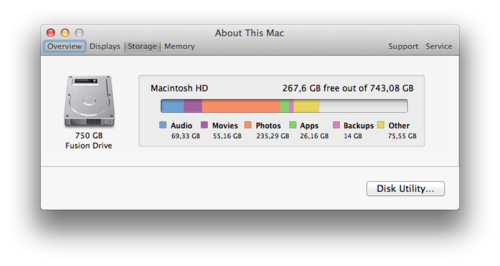
Here’s what the storage allocation now looks like:
And here are the steps I’ve taken:
Making sure that the drive containing my Time Machine backups is working normally and data is readable.
Backing up the most important data on an additional HDD. Just in case. (I also had a third backup: at Backblaze.)
The disassembling and reassembling of the hardware turned out to be easy. The manuals are very detailed and the hardware is laid out pretty obviously anyway.
I’ve used the setup for a day now, and everything’s running smoothly and really fast. Happy, happy, joy, joy.
I’m planning to upgrade my 2011 15” MacBook Pro’s hard drive with an SSD. Currently I’m still running on a 5400rpm 500 GB HDD. When I ordered the Mac two years ago, I intentionally went with the cheapest HDD option – this one – with the plan to upgrade it with an SSD setup 1.5–2 years later when SSD prices have come down. It’s now 2.5 years later and I’m finally looking at some options.
The current situation
I’m primarily looking for the performance increase in the upgrade. But I’m also going to run out of HDD space fairly soon, and it would be nice to still be able to fit all my data on that one machine after the upgrade.
Out of the 500 GB I currently have, most of it is occupied by my photos and movies in the Aperture library. The library is currently taking up 275 GB. I would only need fast access to the more recent photos – not further back than one year. The rest is merely an archive.
My iTunes library is another 55 GB that doesn’t need SSD-grade speed.
So most of these files could live on a/the good old spinning hard drive without a problem. But I’d definitly want to keep my music available on the MacBook’s internal hard drive. I need my music with me at all times.
Here’s what my current storage allocation looks like:
The options
To keep all my data on the MacBook, I’d have to increase the disk space to at least 750 GB. I think this amount would easily last me for the next few years.
Here are the options I am considering, ordered from cheapest to most expensive:
(A fifth option would be to get a 500 GB SSD and the Hardwrk Kit to have a 1TB Fusion Drive internally. But price-wise this is pretty close to option 4, which I would chose over this option anyway.)
The most affordable solution. The Hardwrk Kit replaces the DVD drive with an adapter that can house another drive – HDD or SSD. It also comes with a enclosure for the DVD drive, so you can still use the drive via USB.
I don’t care much for having a DVD drive internally. So making that external via the Hardwrk Kit is perfectly acceptable to me. The only downside would be, that I’d need to take that component apart as well.
Costs: ~ 230 EUR (150 EUR for the SSD, 80 EUR for the Hardwrk Kit)
Disk space: 750 GB, all internally.
Pros: Affordable, enough space, good to great performance increase, good use of existing HDD.
Cons: Performance not as good as a pure SSD setup, more effort installing since I need to replace the DVD drive.
Option 2
The same setup as option 1, but with a more performant SSD.
Costs: ~ 280 EUR (200 EUR for the SSD, 80 EUR for the Hardwrk Kit)
Disk Space: 750 GB, all internally.
Pros: Quite affordable, enough space, good to great performance increase, good use of existing HDD.
Cons: Performance not as good as a pure SSD setup, more effort installing since I need to replace the DVD drive. Not quite as affordable as option 1.
Option 3
Internally, a pure SSD setup. The existing HDD would be put in an external USB enclosure to hold additional data.
Costs: ~ 300 EUR for the SSD.
Disk space: 1 TB, 500 GB internally on the SSD, 500 GB externally on the HDD.
Pros: Great performance increase, price ok, somewhat good use of existing HDD, no messing with the DVD bay.
Cons: Not all data on the MacBook. I would need to start manually relocating parts of the Aperture library onto the external drive and keep managing this.
Option 4
The most expensive option, but certainly the one I’d prefer, if I left costs out of the equation.
Costs: ~ 410 EUR for the SSD.
Disk space: 750 GB SSD-only storage, all internally.
Pros: Great performance increase. Enough space for all my data on the SSD, no messing with the DVD drive bay.
Cons: Expensive, no really good use of the existing HDD.
Decisions, decisions
Option 4 would certainly be the best one performance- and convenience-wise. Also, it might be the most future-proof and least error-prone solution. But is it really necessary to have all my data on an SSD at all times?
FusionDrive seems to work quite nicely and options 1 and 2 would give me the necessary speed plus big storage capacity without having to manage it manually, either. Especially option 1 seems to be great value for money.
I’m least convinced with option 3. Mostly because it means I’d need to start managing data on an external drive in addition to the data on the MacBook.
So, we’ll see. I guess I have to sleep on it for another night or two.
It’s not so obvious, or is it?
Until now, [the students have] always worked for approval, abstracted from results: the question has always been, Is this the answer the teacher wants? or Did the committee like it? — not Is it true? and Did it help the customer?
It’s as if Galileo dropped his ball and feather from the top of the tower and, as they fell, sought to convince his audience by argument instead of simply looking.
This is the way most of us grow up to live, learn, and work. And it’s toxic.
“When I meet people who run design at other organizations, they’re always like, ‘Design is one of the most political areas of the company. This designer likes green and that one likes purple, and whose design gets picked? The one who buddies up to the boss.’
Some companies think of design as an art. We think of design as a science. It doesn’t matter who is the favorite or how much you like this aesthetic versus that aesthetic. It all comes down to data. Run a 1% test [on 1% of the audience] and whichever design does best against the user-happiness metrics over a two-week period is the one we launch. We have a very academic environment where we’re looking at data all the time.
We probably have somewhere between 50 and 100 experiments running on live traffic, everything from the default number of results to underlined links to how big an arrow should be. We’re trying all those different things.”
But then we started using credit cards remotely, first by making payments over the telephone and later for use over computer networks. Neither physical possession of the cards nor a signature on paper could be used for authentication any more. So the card numbers themselves, along with the three digit security (CVV), codes became the means of authentication. As with Social Security numbers, we ended up using a piece of information for authentication that was never designed to be used that way.
A great post on Identification vs. Authentication, and why it’s unclear to some people, how credit cards and the like work.