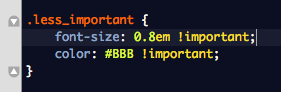
Less important is more important!?
I had to smile when I wrote this. :-)
Less important is more important!?
I had to smile when I wrote this. :-)
Support all browsers to some degree – focus first on the latest and greatest browsers, and then go back and make sure that older browsers look and work reasonably well.
This reflects precisely my approach to creating a website/webapp. I love the new features of CSS3 so much, because they enable me - as a developer - to create a decent UI without having to mess around in Photoshop or write tedious, non-semantic markup just to create good looking buttons, rounded corners etc. The design is implemented quicker, is flexible and the site loads faster, too.
The idea here is to begin with a nice, well-styled presentation that looks good in even archaic browsers like IE6. This is a good thing because even visitors using crappy browsers will be able to read and interact with your content. But instead of stopping there, progressive enhancement says, “let’s provide some additional features for people using better browsers.” After all, people using awesome browsers like Firefox, Safari, and Opera want the best experience possible from the Web. Progressive enhancement says, “let’s give it to them, but only after the less-capable crowd has been taken care of first.”
Unfortunately, when you have a lot of IE users and want to present your site in the best possible way, you have to bite the bullet and create all those buttons and rounded corners in Photoshop.
But I think the ‘progressive enhancement’ method is the best thing you can do. You can offer the best possible visual experience for those who use the latest and most advanced browsers at relative low costs. And for those who use older browsers - well, they probably do not care that much about having the best possible experience on the web anyway.
Altogether, the article is a good read and also provides practical information on the new CSS3 techniques - some of which you might not have heard of yet.

The brilliant Paul Irish built a CSS3 rule generating web app that he calls, “CSS3, Please!” Using automated vendor specific code, you can make
box-shadow,gradient,rgba, evenrotate, work in IE, Mozilla and WebKit.The great news is that this is merely version 1.0. Read his write-up on PaulIrish.com.

I found the first search result for “IE7 inline-block” funny.
Here’s a little CSS-snippet that let’s you select only photos of a certain orientation in your Tumblr theme.
A little warning up-front: it’s not foolproof. It relies on that you post high-resolution photos at a size that fills Tumblr’s maximum photo dimensions, which means, landscape photos should be at least 1280px wide and portrait photos should be 1920px tall.
Update 29.04.2015: I was wrong with assuming portrait photos are always 1920px high. They of course also max out at 1280px in width. So I’ve updated the post to still make it work.
So, here’s how to do it:
The HTML img-tag must specify the width and height attributes. Like this, for example:
<img src="{PhotoURL-HighRes}" width="{PhotoWidth-HighRes}" height="{PhotoHeight-HighRes}" alt="{PhotoAlt}">
This gives you the ability to select images of a certain orientation with a combination of the CSS attribute-selectors and the negation pseudo-class. Assuming your photos are always 1280px wide – no matter if they’re landscape or portrait – you’ll need to specify a :not-selector for each aspect ratio’s height you’re going to use.
So, for example, for a 2:3-ratio, the height would be 1920px and hence the selector would need to reflect that.
Here’s an example how I select only landscape photos by excluding images that have a portrait orientation and have an aspect ratio of 2:3 and 3:4. I use this to make landscape images wider than the otherwise 700px-wide container:
/* only for displays wider than 900px */
@media (min-width: 900px) {
  /* selects landscape <img>s by selecting only the ones that are 1280px wide, and not 1920px tall */
  main .post.photo.photos img[width="1280"]:not([height="1920"]):not([height="1707"]) {
    max-width: 900px;
    margin-left: -100px;
  }
}
For selecting only landscape photos, you can just use img[height="1920"]img[height="1707"].
Again, this won’t work, if you do not upload high-res images. But if you do and want to style photos differently based on their orientation, this might be a good-enough solution for you, too.
As I start adding content to this blog more regularly, I thought I update – and I think improve – its design a little. Today I updated the headings and navigation links.
While I was previously using a single serif font for the whole site, I now introduced a second font for the mentioned elements: “Helvetica Neue Condensed Bold”.
I think this font is a good pairing to the serif body font. The upper-case Helvetica more clearly separates posts from one another and makes navigation links stand out more. I often think a two-font serif/sans-serif pairing looks good and I’m glad I now found one that I like using fairly common fonts. I particularly like it because of the condensed variant (my thanks goes to zeldman.com for the inspiration).
During implementation, I noticed it wasn’t very consistent to implement across Mac/iOS browsers, though.
Normally the following CSS should have been enough in my opinion:
font-family: "Helvetica Neue", Helvetica, Arial, sans-serif;
font-stretch: condensed;
text-transform: uppercase;
For Safari and Firefox on a Mac, this is enough indeed and for iOS as well. But Chrome on the Mac wouldn’t show the condensed variant of the font. I had to add the condensed variant (its Postscript name to be precise) as a font-family:
font-family: "HelveticaNeue-CondensedBold", "Helvetica Neue", Helvetica, Arial, sans-serif;
This made Chrome (and Opera) show the same condensed version on a Mac as the other two browsers. For Safari however, this overwrites the "Helvetica Neue" + font-stretch statement again. But Firefox seems to ignore the additional font-family and still uses the font-stretch statement.
Anyhow, this works now and I thought I share this little CSS-inconsistency finding here.
In a future update I might look into having Android and Windows show a condensed font, but for now I’m fine with the fallbacks in this font stack.
I recently learned that it’s very practical to use a unit-less number to specify the CSS line-height. Unlike using a unit – like em, for example – this will make the line-height dependent on the text’s font-size, instead of being an absolute value.
Here’s a little example.
The markup (excerpt):
<body>
  Lorem ipsum dolor sit amet, consectetur adipiscing elit, sed do eiusmod tempor incididunt ut labore et dolore magna aliqua.

  <p>
    Lorem ipsum dolor sit amet, consectetur adipiscing elit, sed do eiusmod tempor incididunt ut labore et dolore magna aliqua.
  </p>

  <blockquote>
    Lorem ipsum dolor sit amet, consectetur adipiscing elit, sed do eiusmod tempor incididunt ut labore et dolore magna aliqua.
  </blockquote>
</body>
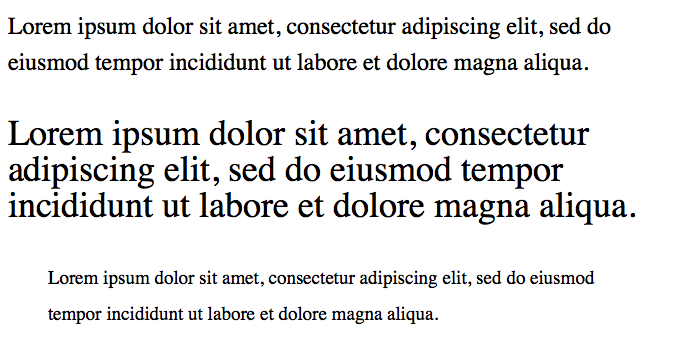
And here’s the CSS with unit, and the corresponding screenshot:
body {
  font-size: 1.5em; // 24px
  line-height: 1.5em; // 36px
}
p          { font-size: 1.5em; } // 36px, line-height still at 36px
blockquote { font-size: 0.8em; } // 19.2px, line-height still at 36px
And here’s the CSS without unit. This looks far more balanced:
body {
  font-size: 1.5em; // 24px
  line-height: 1.5; // 36px
}
p          { font-size: 1.5em; } // 36px,   line-height: 54px
blockquote { font-size: 0.8em; } // 19.2px, line-height: 28px
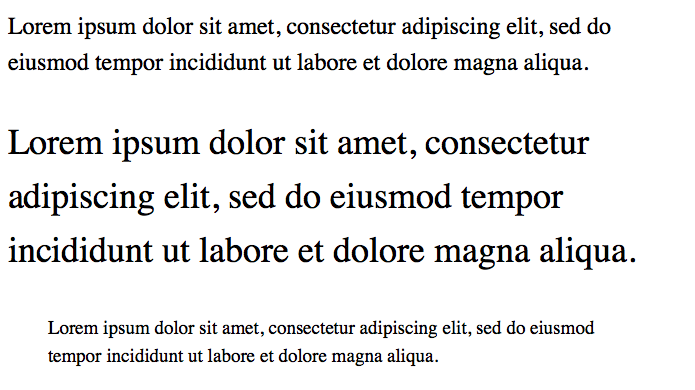
Using a unit-less number seems to be a better default, because the text generally looks better when its line height is based on its font size. I seem to need less line-height statements in total and the typography looks generally more appealing.
For one-column responsive layouts – like this blog for example – I like using width-based font sizes. Using the vw (view width) unit, the font size automatically scales based on the width of the viewport. It’s perfectly responsive without the need for media query breakpoints (at least initially, see below).
Here’s what I found to be a good calculation:
body {
  // 1em minimum font size (usually 16px) plus
  // 0.7% of the browser window’s total width
  font-size: calc(1em + 0.7vw);
}
This however stops working as intended, once the viewport starts becoming wider than the container the text resides in. It’s very common (for me anyway) to specify a maximum width of the main element that holds the text. But vw takes into account the width of the whole browser window, which inappropriately keeps increasing the font size, while the container width remains at the maximum width specified.
For example, this blog currently specifies a max-width of 700 pixels for its main content. So, I’d like to calculate font size based on the container width of 700px instead of the whole browser window width:
@media (min-width: 701px) {
  body {
    font-size: calc(1em + 700px * 0.007);
  }
}
However, since the calculation is static, I ended up simply calculating it myself in ems and use that:
@media (min-width: 701px) {
  body {
    font-size: 1.306em;
  }
}
Can’t we just get max-font-size?
While deciding on these statements above, I also tried out CSS variables to store certain values like the max-width of the container etc. to calculate the font-size like so:
:root {
  --container-max-width: 100vw;
  --base-font-size: 1em;
  --container-fraction: 0.007; /* 0.7% */
}

body {
  font-size: calc(
    var(--base-font-size) +
    var(--container-fraction) *
    var(--container-max-width));
}

@media (min-width: 701px) {
  body {
    --container-max-width: 700px;
  }
}
But with this I
So, I decided against using them. For a more complex project, this might be a different story, but for a simple site with a pretty static design, that’d be total overkill and backwards in my opinion.
For tools and utilities – like my focal length equivalent site for example – I like the idea of using the UI font of the operating system it is running on. The site’s typography better blends in with the OS that way and hence makes the site seem more familiar to its visitors.
Here’s the simple CSS statement I’m using:
font-family: system-ui, sans-serif;
system-ui seems to be the new standardised value for using the default operating system font. It’s not supported in all browsers, but coverage is not bad at all.
My chosen fallback is simply sans-serif. I don’t think there’s any OS that’s using a serif font on the UI. Also, specifying the popular Helvetica, Arial in addition is pretty much redundant, as one of them is the default (and probably preferred) sans-serif font on its platform anyway.
For my Focal Length Equivalent utility, I created a alternative view for when you don’t have JavaScript enabled (as you should, if you can).
Instead of dynamically showing the conversion based on the position of the range slider input element, I simply show a good old table with calculated equivalents at pre-defined focal lengths.
I wanted this table to list the focal lengths vertically – with one film- or sensor-format on one row – so you can easily parse the result. As such a table gets easily too wide for the parent elements container, I wanted
Here’s the simplified table markup:
<figure><table><tbody><!-- ... --><tr><th scope="row">35mm</th>
        <td>10 mm</td>
        <td>16 mm</td>
        <td>24 mm</td>
        <td>28 mm</td>
        <td>35 mm</td>
        <td>50 mm</td>
        <td>85 mm</td>
        <td>100 mm</td>
        <td>135 mm</td>
        <td>200 mm</td>
        <td>300 mm</td>
        <td>500 mm</td>
      </tr><!-- ... --></tbody></table></figure>
The “scrolling” bit is easily done: simply put a overflow-x: scroll; on the table’s container element, which in my case is a <figure> element (a <div> or any other block element would also do of course, if the <figure> semantic doesn’t work for you):
figure {
  overflow-x: scroll;
}
In order for the film-format name headings to keep their position, I resorted to a fairly new value of the CSS position property: sticky. I added this to the th selectors, in combination with left: 0; so the headings stay at their original positions:
figure table tr th {
  position: sticky;
  left: 0;
  // you might also want a bg color, so the th covers the table
  // that scrolls through underneath
  background-color: white;
}
You can take a look at this when you go to the tool and disable JavaScript in your browser. Or you can simply look at this table here:
| Micro 4/3 | 5 mm | 8 mm | 12 mm | 15 mm | 18 mm | 26 mm | 44 mm | 52 mm | 70 mm | 104 mm | 156 mm | 260 mm |
|---|---|---|---|---|---|---|---|---|---|---|---|---|
| APS-C | 7 mm | 11 mm | 16 mm | 19 mm | 23 mm | 33 mm | 57 mm | 67 mm | 90 mm | 133 mm | 200 mm | 333 mm |
| 35mm | 10 mm | 16 mm | 24 mm | 28 mm | 35 mm | 50 mm | 85 mm | 100 mm | 135 mm | 200 mm | 300 mm | 500 mm |
| 6x4.5 | 16 mm | 26 mm | 39 mm | 45 mm | 56 mm | 81 mm | 137 mm | 161 mm | 217 mm | 322 mm | 483 mm | 805 mm |
| 6x6 | 18 mm | 29 mm | 44 mm | 51 mm | 64 mm | 92 mm | 155 mm | 183 mm | 247 mm | 366 mm | 548 mm | 915 mm |
| 6x7 | 20 mm | 32 mm | 48 mm | 56 mm | 71 mm | 101 mm | 171 mm | 202 mm | 272 mm | 404 mm | 604 mm | 1009 mm |
| 6x8 | 22 mm | 35 mm | 53 mm | 62 mm | 77 mm | 110 mm | 187 mm | 220 mm | 297 mm | 440 mm | 660 mm | 1100 mm |
| 6x9 | 23 mm | 37 mm | 56 mm | 65 mm | 82 mm | 117 mm | 198 mm | 233 mm | 315 mm | 467 mm | 700 mm | 1167 mm |
| 4x5 | 36 mm | 57 mm | 85 mm | 99 mm | 124 mm | 177 mm | 301 mm | 354 mm | 478 mm | 708 mm | 1061 mm | 1769 mm |
| 8x10 | 71 mm | 113 mm | 170 mm | 198 mm | 248 mm | 354 mm | 601 mm | 707 mm | 955 mm | 1415 mm | 2122 mm | 3537 mm |
If you didn’t know, it’s perfectly valid to use the <noscript> tag inside the “ element of a HTML page. And you’re allowed to include <link>, <style> or <meta> tags as its children.
I use this for my little focal length equivalent utility, by loading an additional stylesheet via a <link> tag: when a visitor has JavaScript disabled, it loads the style for the alternative <table> that’s also wrapped in a <noscript> element.
This blog has had a dark mode for a while now. Toggling it on and off could be done manually, and the selected preference would be stored in your browser for the next time you return.
I’ve now extended the script that handles the switching to respect your operating system’s preference for dark mode. This uses matchMedia and MediaQueryList.addListener to do so. Take a look at the whole script, if you like.
I don’t know, if any other operating systems other than macOS Mojave have a “Dark Mode” preference. But, if you happen to run Mojave and use the Safari 12.1 Beta or Technology Preview, you can try this out yourself. But here’s a little GIF of what it looks like:
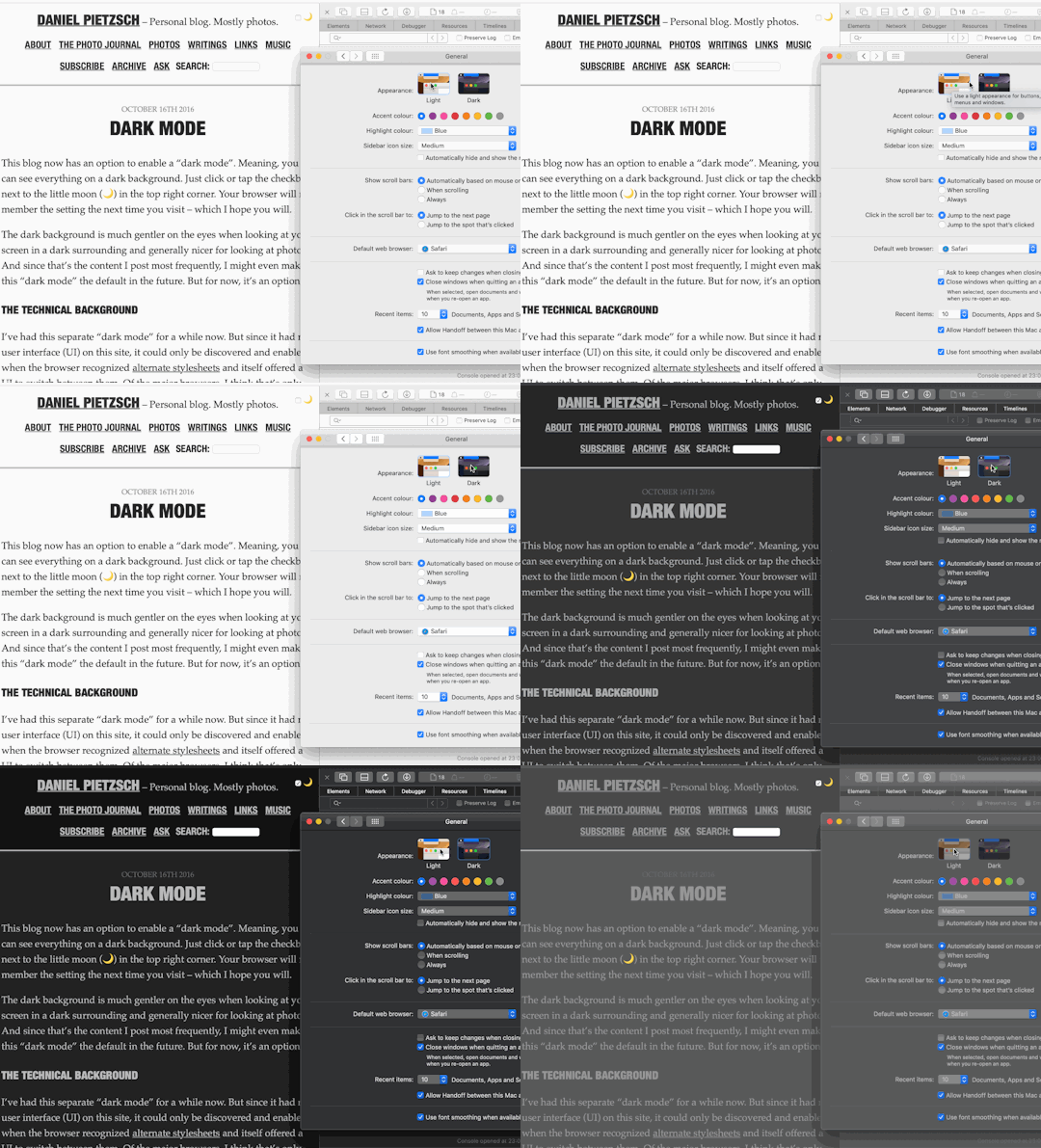
The whole usability around this feature is not ideal currently. For example, I should probably have a 3-way switch – On, Off, Auto – instead of a simple checkbox toggle. And I should make an “Auto” setting work without JavaScript. But I didn’t have the time for this tonight, and so this will be a little project for another time.
My little Focal Length Equivalents tool now features “automatic dark mode” on supporting operating systems and browsers. Meaning, when you have your operating system set to prefer a “dark” styling – like macOS Mojave offers for example – and you are using a compatible browser, the page will show with a dark background and bright text. If your operating system is set to something else, it will show the default white background and black text.
Unlike for my blog, this solution uses CSS only. I simply put the required media query at the end of the CSS file(s) and by doing so, overwriting existing default colours with the ones used for dark mode.
/* AT THE END OF THE CSS FILE. DEFAULT STYLING ABOVE THIS MEDIA QUERY */
@media (prefers-color-scheme: dark) {
  body {
    color: #DDD;
    background-color: #222;
  }

  a { color: #88F; }
  a:visited { color: #AAF; }

  body > footer {
    border-top-color: white;
  }
  /* ETC ETC */
}
Overwriting the colours like this could become unmaintainable in a more complex setup, but for this little page, this works just fine.
I amended my photo journal’s design once again. I wanted to make all images fit completely on screen, no matter what the actual dimensions of the image are.
That images wouldn’t fit was mainly an issue with photos shot in portrait orientation or in square format. If a screen was wider than it’s tall – typical for most non-mobile devices – and you had less than 960px available vertical space, those images would be cropped. That’s no longer the case. And I find it much more enjoyable when the whole picture fits on screen.
As a minor downside, this update also decreases the size of landscape-oriented images, which would still have fitted previously. But this way, everything’s aligning well and portrait and landscape images still have the same size.
Just learned about the CSS clamp() function. This would actually be really handy for specifying a width based font size, without the need for an extra media-query.
Unfortunately, this does not have any browser support right now.