There’s currently – and again – a discussion going on in Germany about whether to enforce a general speed limit (“Tempolimit”) on the German Autobahn. I’m not going to argue for or against that general limit here – I’m all for it, though – but wanted to share a personal anecdote where I experienced that no speed limit was dangerous.
The setting is a pretty empty two-lane Autobahn as it might be the case on a weekend morning. Now, I drive a camper van1 and usually drive at a speed around 100 to 110 kph. Occasionally there’s a truck or otherwise slow vehicle to overtake, even for me. On a two-lane highway, I always get nervous. I take great care not to overtake after a hill or a corner, but if someone’s approaching at 200+ kph I still might not notice him2 until it’s too late. Because even when I make sure it’s all clear before I start the overtaking manoeuvre it might take a while at 120 to 130 kph. I can remember two occasions where vehicles came very close at high speed. And the drivers were furious – middle finger and all. I’m not quite sure if the situation was indeed dangerous, or whether that person simply wanted to teach me a lesson. But from my point of view, I couldn’t anticipate his car.
On a three-lane highway I’m not nervous, because you can pretty much rely on that everyone that’s super-fast is on the left lane and everyone else is on the other lanes – the lanes that I stick to – at a maximum speed at around 140 kph I’d say. That makes overtaking easy to predict and stress free for me in my slow (for German standards) motorhome. But I dread that almost empty two-lane no-speedlimit stretch.
I know, one of the typical enemies of people who like to drive fast. Fuckin’ hippies and old folks (who can’t fuckin’ drive in the first place)! ↩︎
Today started with a shocker: Our camper was gone from the spot I had parked it a couple of days ago. My heart started racing as I thought it was stolen. I sent Nicole into shock, too, before I realised, I might have parked too close to a fire brigade access – although I took care I wasn’t when parking it1. Sure enough that was the problem and the camper only got towed. Phew! Still, this wasn’t and isn’t a cheap mishap: a big invoice for the towing plus more fines to come, when I interpret the note on the windshield correctly. I guess that’s fair enough. But man, I didn’t have a good day today.
To my defense, suitable parking spots for campers are hard to come by in the city. ↩︎
I often struggle finalizing a monthly edit for my photo journal. I’m never quite sure what frames to pick and which to kick.
The first and second round of culling is quickly done, but really narrowing it down takes me quite a while. And it’s one reason I’m so far behind with posting there1.
The journal is not meant be a portfolio, and so I don’t really see the need nor do I want to only select the very best shots. But I’d like to select a somewhat tight selection that still communicates what that month was like.
And that’s really the bit I’m fighting with. While the target audience is primarily myself, I still want to display the photos in a way other people find it interesting, too. If only to make sure that I find the selection still interesting in a few years time. I don’t want to go through two hundred photos per month, but I don’t want to leave out things that I might miss later, either.
So, each month’s selection will probably always contain – and be allowed to contain – images that are nothing special, but where I feel they need to be in there to better tell the story. But it’s not easy for me to let go of certain photos. And I often procrastinate on the editing process, because I dread deciding which additional frames to remove from what I consider an already tight edit – which I know or feel it is actually not.
Maybe I should constraint myself to speed things up: simply stick to a fixed number of images – say a maximum of thirty photos per month – and work within that limit. But, what if I shot a lot of street and otherwise documentary photography and simply want to share more? Maybe put them somewhere else? Here? I really don’t know. Maybe “simply” get better at editing. But how?
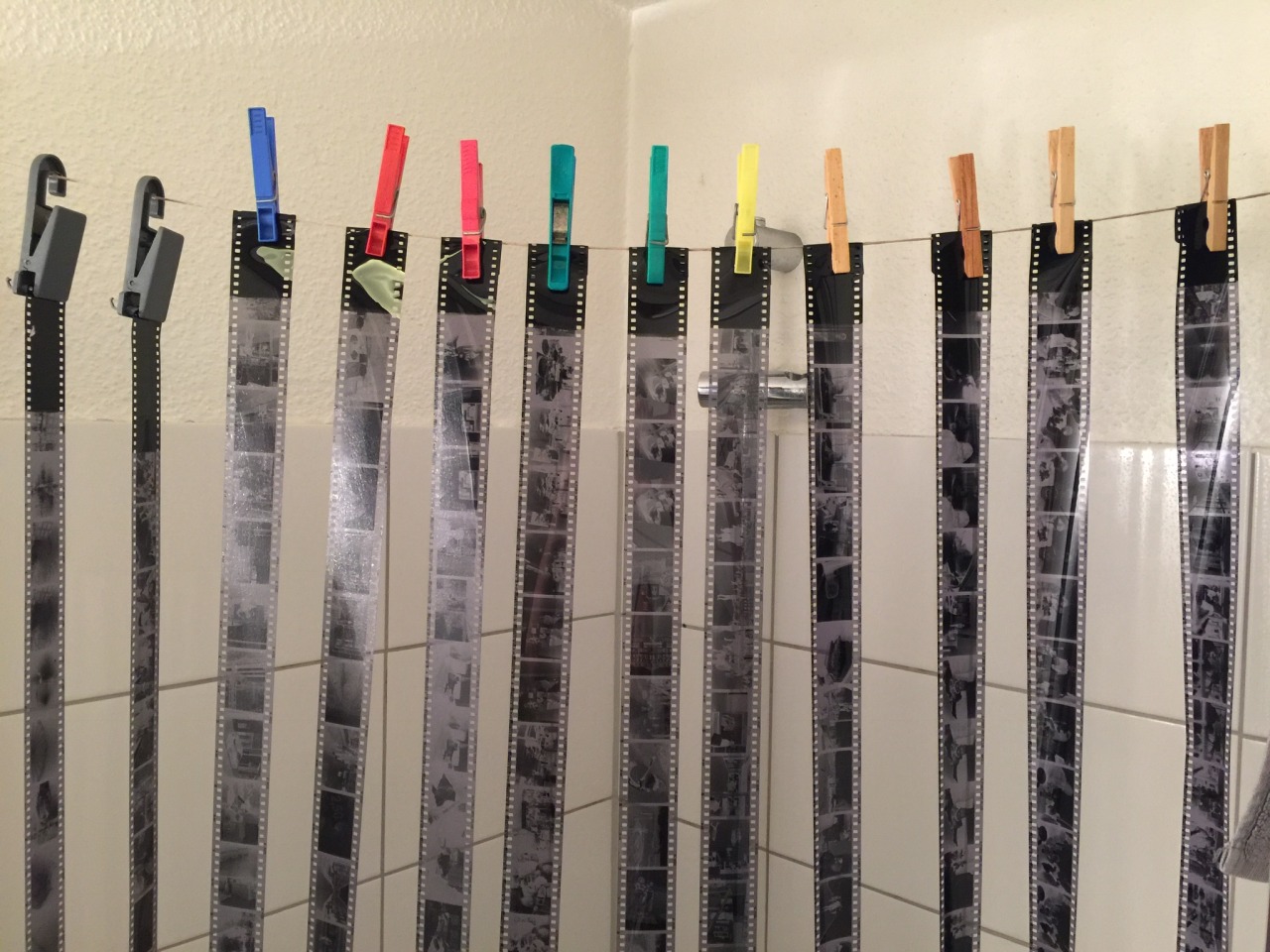
Negative strips hanging to dry in our shower.
Right after the reason, that I accumulated a lot of unprocessed rolls during last year’s travels, which I had to catch up developing and scanning. ↩︎
Having no instant feedback shooting film, also means I sort of get to re-experience a moment one more time. Simply because I can only look at a photo much later. And when I finally get to see the negatives and/or the scans, I get taken back to that moment.
I also get to enjoy the suspense and the surprise: “Did I get the shot how I imagined it?“ “Oh, that’s a detail I didn’t see when taking the shot!” Or – when I develop the film much later – “nice, I forgot about that frame”.
It’s always exciting taking the film off the reel after developing it, holding it up to the light and looking at this long strip of negatives. There’s always a surprise waiting.
Of course, I also get to experience the disappointment when something didn’t turn out. But that’s part of the game, and what makes it exciting in the first place.
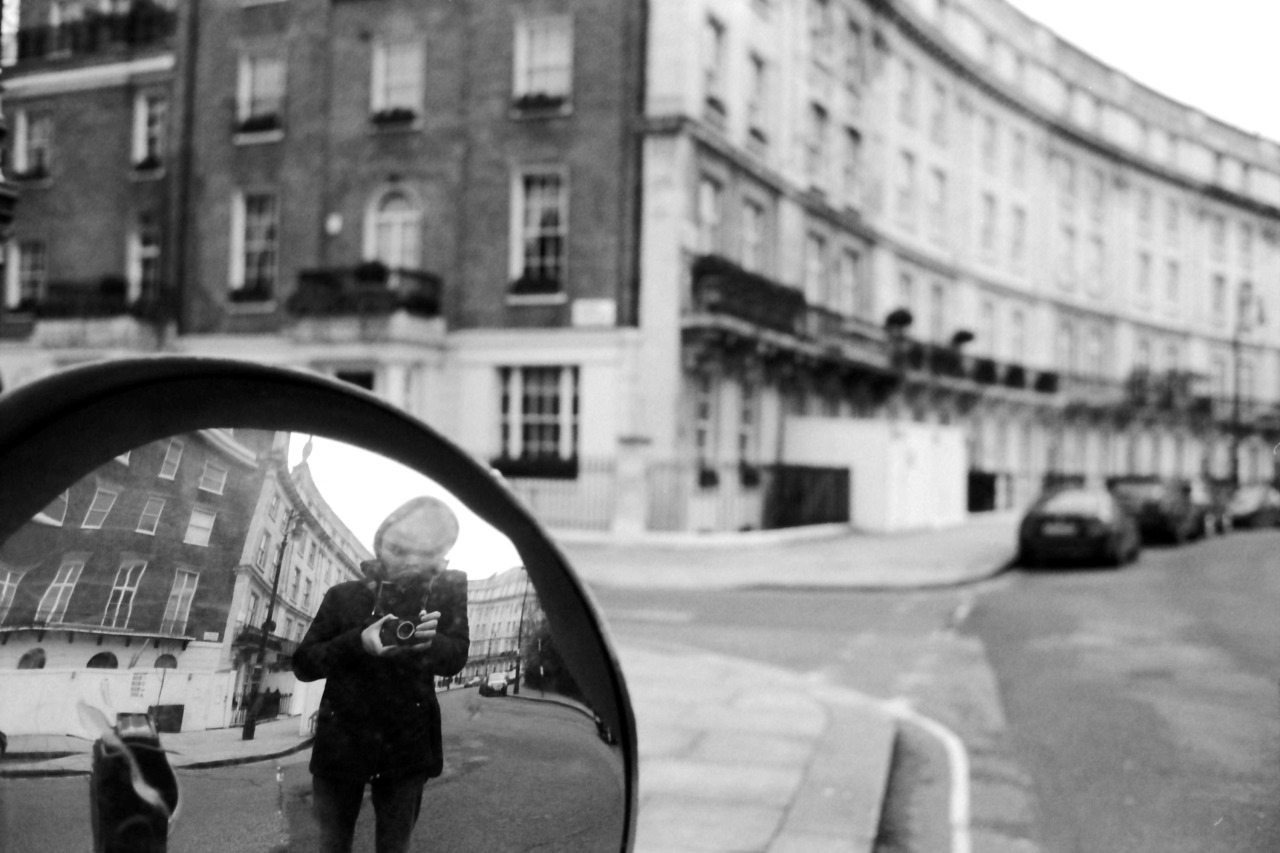
Couldn’t have guessed how this would turn out.A very spontaneous hipshot after turning around.
Journaling again. That’s how it goes when you don’t have anything pre-written. Because so far into this project, I’ve been writing day-to-day, which sometimes means my writing turns out really short or meta. Or it’s a journal entry like this one. So, here we go.
Yesterday night was pretty unusual: Nicole and I went out together, which hasn’t really happened much since we had Zoe. We went to see Mastodon and Kvelertak in Oberhausen. Felt exciting sitting in the car all by ourselves, with a Wegbier, driving into the night. ;-)
And we had a great time. Kvelertak put on their sweeping performance and had the best sound of the night. And Mastodon played an amazing 100+ minute set. We just wished they’d thrown in a couple more of our favourite songs.
Usually I take my camera everywhere, but this time I thought, “nah, let’s just enjoy the gig and do not carry the camera around”! And I regretted that decision. What was I thinking?
Then today I got the other left wisdom tooth removed. This time it was from the upper jaw; maybe that’s why afterwards it’s not hurting as much. Definitely feeling better than last time.
When you browse the web for information on film cameras, you’ll occasionally – or even regularly – stumble upon websites that look very dated. One example I recently came across was a site that offers scans of film camera manuals in PDF format: the “Camera Manual Library”.
The sub-heading states “1997 – 2018”. And it definitely looks like being from the former of those two years: It makes use of table layouts, <font>- and <marquee>-tags, old-school animated GIFs, <body>bgcolor- and link-attributes and much more. A proper blast from the web’s childhood past.
But you know what? It still works today. Twenty or so years after it was originally created. It gets the job done without any fancy new tech. And without the need for anyone to update its markup and design over the years. That’s pretty remarkable, if you ask me! Good luck using your apps in just a few years.
Recently, my Leica Mini Zoom compact camera wasn’t able to rewind a film after reaching the end of the roll. The result was that the film was stuck inside. Eventually, I managed to get it out again.
As most – if not all – electronic consumer film cameras, the Leica Mini Zoom automatically rewinds the film when it reaches its end. This time that wasn’t the case, probably because I used a bulk-loaded film. I can only guess what the exact reason was. But I suspect it was the way I taped the strip of bulk-film to the little bit of original film of a pre-used canister of HP5. And this then confused the rewind mechanism and prevented it from doing its thing.
The problem was that the take up spool was still locked and wouldn’t even let me pull off the film strip manually.
Preparations
For my attempts to rescue the film, I first put the camera into a dark bag, so it was safe to open the camera without exposing the film. I also put into the bag a drawing pin – to press in the tiny rewind button – and a developing tank – so that I could place the film directly in there after freeing it (and hence continuing to shield it from light).
I didn’t have any luck with the drawing pin and the rewind button: the camera would only pull the film further onto the take-up spool, and wouldn’t unlock the spool, either.
The solution
What was successful in the end was this: I first cut off the film from the canister. Then I pushed the film further into the camera and onto the take up spool until I only had a little bit of film left to hold on to 1. The take up spool didn’t move while doing this, so this step was loosening the tension of the film on it. Then I pulled on the film using a little bit of force as I reached the tension point again. And this forceful pulling managed to retrieve a few more centimetres of film each time2. Repeating these steps, I was able to recover more and more of the stuck film strip. And eventually the take up spool unlocked and I could simply pull off the remaining film in one last go.
Originally, I had the film taken up completely by the spool after cutting it off and pushing the rewind button again. But after pushing it a few times more, I was able to grab a short bit of film again and start with the described recovering steps. ↩︎
The pulling did make the material protest in form of a bit of cracking noise. But I (hope I) didn’t overdo it. The camera still seems to work. ↩︎
I wouldn’t say that everything I’ve published so far really qualifies as “writing”, but that’s ok. My goal is more to publish at least a little bit of originally written text every day, and build a new habit.
And once again, I find that writing is one of those things that seem easy, but when you actually do it, it really isn’t.
It feels intimidating to still having eleven months to go, but I remain optimistic. As I mostly do.
Please display the publishing date of your articles or blog posts on the page. It regularly drives me crazy, when there is none.
For some content, it might not be as important, but for a lot of articles it’s very relevant whether they were written one month, one year, or one decade ago.
Ideally, put it right at the top of the post, around its heading (I just updated this very blog and did just that). Then nobody has to scroll through the whole article first to find it.
And please be unambiguous: include year, month and probably the day, too. Definitely don’t skip the year, or at least make it clear, that when there’s no year printed, you mean the current.
Today I got a wisdom tooth removed. I’m just grateful that we live in times of modern anaesthetics. Didn’t want to have to go through this procedure on Whiskey alone.
They only had time for one of the two teeth that are causing problems, so next week I have another appointment…
While I am speaking of Zoe: she is so much fun at the moment! She’s walking and running, she’s talking (sort of, in her toddler way), she’s dancing, she’s cuddly, she understands a lot of what we say, she’s curious, and – to our great delight – she started giving out kisses, too. 😍
Spent most of the day with dad clearing out our cellar and his old stockroom and driving all the things to various recycling facilities.
Things finally had to go.
I don’t think I am required to do any additional sports this week.
And the highlight of my day was returning home: I’m currently rarely gone for an entire day, which is probably why Zoe was so happy to see me again. She gave me the biggest and longest hug I’ve received from her ever. Best thing in the world! :-)
On both my Mac and my iOS devices, I use Safari as my main browser. It’s fast, secure, prevents tracking, syncs across platforms and makes the best use of the underlying OS’s resources and hence helps with long battery life. And since it recently gained the ability to show favicons on each tab, there’s not much I’m missing.
Ideally though, I would use Mozilla’s Firefox. It’s just as good. And furthermore, it’s developed by a not-for-profit organisation and the only major browser – complete with its own rendering engine Gecko – that’s not maintained by one of the enormous global for-profit corporations. Which is good for the diversity of the browser landscape and the web as a platform.
What’s holding me back, though, is that I can’t specify a different default browser on iOS. Yes, I enjoy seemingly best battery life using Safari, but I would trade this for using an independent browser. But it’s pretty inconvenient to have links always open in Safari when my main browser is actually something else.
While it’s shitty enough1 that Apple doesn’t allow different rendering engines on iOS2, it seems deliberately anticompetitive they don’t allow you to specify another default browser.
Can’t someone force Apple to make this change, please?
And regarding Google’s Chrome (which is the browser with the biggest market share): I can’t think of a reason to use it as my main browser. For me, it doesn’t offer anything better than Safari or Firefox and it’s from a company I have low trust in.
One of the biggest advantages for me when shooting film is that after taking the photo, there’s nothing to see. Neither I nor anyone else can see the photo I just took. This keeps me and everyone else in the moment.
With film, it’s clear you can’t see the image immediately. And so nobody wonders or asks. No checking possible of how something or someone looks in the photograph. It’s less intrusive compared to a camera with a screen.
That makes film perfect for me when capturing moments with family and friends: because in these settings I’m a participant first and a photographer second.