iOS 6 doesn’t make the iPhone 3GS any slower or more difficult to use than it was before, which should be good news to anyone who keeps theirs around as a secondary or backup phone—indeed, it’s pleasantly surprising how many of the refinements and improvements make their way down to Apple’s oldest-supported piece of iOS hardware.
Helpful article for all the 3GS users -like me - wondering whether to upgrade to iOS6 or not.
Seems like more and more point-and-shoot cameras are getting wireless connectivity and a powerful operating system.
I am not interested in these point-and-shoot cameras per se, but it will be interesting to see when and how these features make it into the enthusiast and pro cameras.
Until now, [the students have] always worked for approval, abstracted from results: the question has always been, Is this the answer the teacher wants? or Did the committee like it? — not Is it true? and Did it help the customer?
It’s as if Galileo dropped his ball and feather from the top of the tower and, as they fell, sought to convince his audience by argument instead of simply looking.
This is the way most of us grow up to live, learn, and work. And it’s toxic.
For some reason my Mac suddenly stopped downloading photos from iCloud’s Photo Stream. The folder at ~/Library/Application Support/iLifeAssetManagement/assets/sub/ didn’t contain any photos taken after a certain date.
The following steps fixed this for me:
Go to System Preferences -> iCloud.
Disable “Photo Stream”.
Wait a few minutes (this seems to be important, because the first time I tried, I turned it back on after a couple of seconds already and that didn’t fix my problem).
Enable “Photo Stream”.
After this, the Photo Stream folder started filling up again with all the photos my Mac hadn’t downloaded so far.
Finally, more sophisticated software is making its way onto cameras. This is going to be huge, I think. When you look at the camera usage stats on Flickr, it’s two smartphones - the iPhone 4 and 4S - that take the two top spots amongst all cameras.
Personally, I think having a full Android OS running on a camera, seems to be too distracting. And - unsurprisingly - battery life is greatly diminished.
But WiFi connectivity, great apps for editing and organisation, plus the ability to upload your photos straight to a website and/or your computer/tablet is a huge win and something I miss with “real” cameras.
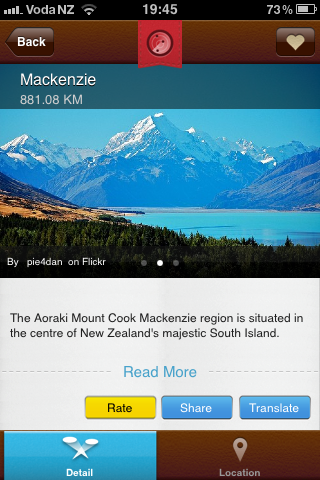
I open-sourced the small photo overlay class I wrote for NZ Walks. It’s a custom overlay for the Google Maps API v3 that can display small photo thumbnails on the map.
“When I meet people who run design at other organizations, they’re always like, ‘Design is one of the most political areas of the company. This designer likes green and that one likes purple, and whose design gets picked? The one who buddies up to the boss.’
Some companies think of design as an art. We think of design as a science. It doesn’t matter who is the favorite or how much you like this aesthetic versus that aesthetic. It all comes down to data. Run a 1% test [on 1% of the audience] and whichever design does best against the user-happiness metrics over a two-week period is the one we launch. We have a very academic environment where we’re looking at data all the time.
We probably have somewhere between 50 and 100 experiments running on live traffic, everything from the default number of results to underlined links to how big an arrow should be. We’re trying all those different things.”
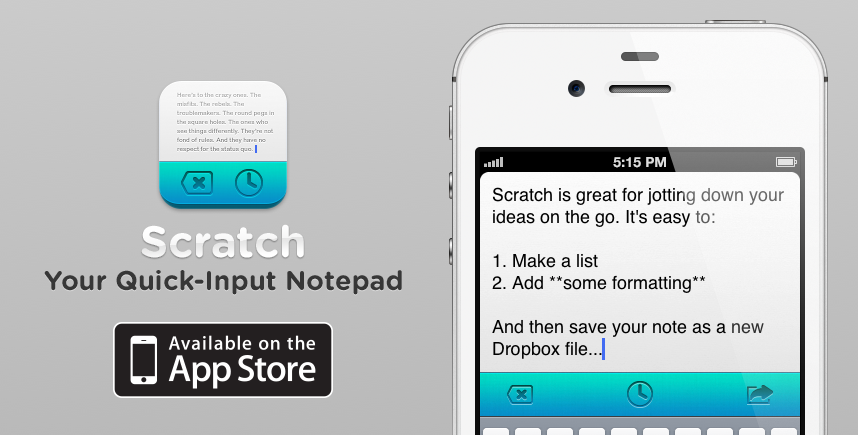
We’ve made loads of apps for clients at Karbon, but this is the first app we’ve made for ourselves. I’m excited to announce the immediate availability of Scratch. We hope it will become your favorite quick-input notepad. It’s crammed full of features like customizable and Markdown toolbars, Dropbox support for appending to existing files or creating new ones, built-in sharing to Twitter and more. It launches lightning-fast, too, and it always jumps right into edit mode so you can start typing right away.
The great thing is Scratch allows you to quickly clear your existing note, but stores all cleared notes in a searchable history so you never have to worry about losing anything. There’s no silly file management to deal with.
The interesting (to geeks like us) part is this: what system that works like Twitter could exist without a company behind it?
Think about it this way:
Under the hood, following somebody is really just subscribing to a feed of their statuses. Posting is really just updating a feed of your own statuses.
So you standardize on a feed format. RSS would work great, of course, and there’s a ton of RSS reading and writing code out there already — and it’s not like it’s dead. (For instance, just this week Apple released a major iPhone app that uses RSS.)